On May 4, 2024, the team of Professor Guo Zhi from the Department of Hematology at Huazhong University of Science and Technology Union Shenzhen Hospital, together with the team of Professor Wang Jianxun from Shenzhen Cell Valley, jointly published a case report titled "Rapid response in relapsed follicular lymphoma to novel anti-CD19 CAR-T therapy with pseudo-progression and cytomegalovirus infection: A case report" in the SCI-indexed journal International Immunopharmacology (CAS Zone 2, IF 5.6). The corresponding authors of this case report are Professor Guo Zhi, Associate Chief Physician Liu Liqiong from the Department of Hematology at Huazhong Union Shenzhen Hospital, and Professor Wang Jianxun, Chief Scientist of Shenzhen Cell Valley. The co-first authors are Chief Physician Zhong Nan, Assistant Researcher Ma Qihong, and Assistant Researcher Gong Shiting from Shenzhen Cell Valley.
This case demonstrates the successful treatment of a patient with relapsed follicular lymphoma complicated by cytomegalovirus infection using a novel anti-CD19 CAR-T product manufactured by Shenzhen Cell Valley. The patient achieved complete remission after CAR-T infusion and has remained relapse-free for over seven months to date, indicating clinical cure.
This case confirms that the novel CD19-targeting CAR-T cells prepared using retroviral vector technology by Shenzhen Cell Valley demonstrate good efficacy, safety, and treatment response in patients with drug-resistant relapsed follicular lymphoma, meeting all expectations.
Shenzhen Cell Valley is committed to empowering R&D, accelerating clinical translation, reducing industrialization costs, and bringing new hope to patients—ensuring that quality products leave the laboratory and truly serve clinical needs. Currently, Shenzhen Cell Valley maintains close collaboration with the Department of Hematology at Huazhong Union Shenzhen Hospital, having conducted multiple clinical treatments using novel CAR-T cells targeting CD19, BCMA, CD19/CD22, CD7, CD38, and other targets, all based on retroviral vector technology, demonstrating favorable efficacy and safety. Going forward, both parties will further strengthen their collaboration in clinical research on CAR-T and other cellular immunotherapy products.
Shenzhen Cell Valley provides safe, high-quality, and affordable GMP-grade retroviral vectors and cell therapy products, ensuring the safety and efficacy of cell therapy products and driving the overall development of the cell and gene therapy industry.
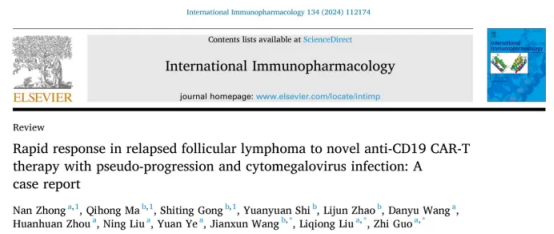
Figure 1: Case Report Publication Information
(DOI: 10.1016/j.intimp.2024.112174)
Case Report Summary
The following is excerpted from the case report, briefly describing the clinical course of a patient with relapsed follicular lymphoma complicated by cytomegalovirus infection treated with a novel anti-CD19 CAR-T therapy.
A 40-year-old male patient presented in early May 2021 with a palpable, firm, painless mass in the subxiphoid abdominal region without obvious predisposing factors. He reported no symptoms of nausea, vomiting, or weight loss. Following multiple examinations including CT, tumor biopsy, and immunohistochemistry (Figure 2), the patient was diagnosed with lymphoma, with follicular structures predominant in the lymphatic system tumor, consistent with follicular B-cell lymphoma, Grade 2, Stage 3, with a FLIPI score of 2. After several rounds of chemotherapy, the patient's condition improved slightly. On September 5, 2023, a follow-up PET-CT (Figure 2B-b) indicated tumor suppression with partial remission (PR) after treatment, though residual lesions remained. The attending physician decided to proceed with CAR-T therapy.
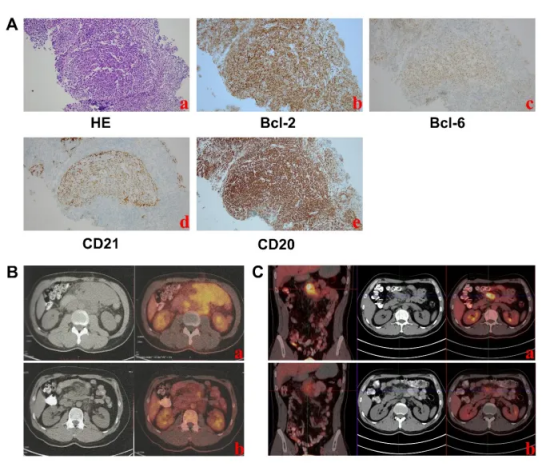
Figure 2: Pre-CAR-T PET-CT Images and Pathological Sections. (A) Pathological findings of the abdominal mass prior to CAR-T infusion. a: Hematoxylin-eosin staining. b-e: Bcl-2 positive, Bcl-6 positive, CD21 positive, CD20 positive. (B) Timeline of PET-CT images from initial diagnosis and effective treatment of the abdominal mass. a: 2021-5-26. b: 2021-12-14. (C) Timeline of PET-CT images at abdominal relapse and during immunomaintenance therapy. a: 2023-2-16. b: 2023-9-5.
Leveraging its superior product quality, solid and efficient service, top-tier technical team, and excellent corporate reputation, Shenzhen Cell Valley successfully won the bid for Huazhong Union Shenzhen Hospital's "GMP-grade CAR-T Cell Preparation" project. For this case, Shenzhen Cell Valley provided GMP-grade novel CD19-targeting CAR-T cells prepared using retroviral vector technology. The GMP-grade CAR-T cells exhibited a positivity rate of 52.9% and purity of 100%, strictly meeting release criteria (Figures 3A, 3C).
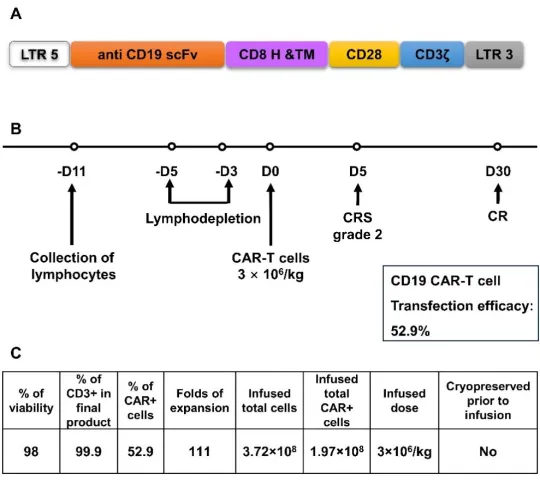
Figure 3: Construction of CD19 CAR-T Cells and CD19 CAR-T Cell Infusion Protocol. (A) Schematic diagram of the CD19 CAR vector. (B) CAR-T infusion protocol: FC regimen used for lymphocyte depletion; CAR-T cells infused at a dose of 3×10⁶/kg. (C) Quality specifications of CD19 CAR-T cell product.
Lymphocytes were collected from the patient 14 days prior to infusion. Following preconditioning with fludarabine and cyclophosphamide for lymphocyte depletion, 50 mL of CD19 CAR-T cells (3×10⁶/kg) were infused 5 days later (Figure 3B). Two days post-infusion, the patient developed Grade 2 CRS, with bilateral submandibular lymphadenopathy, a sharp increase in IL-6, high fever (39.8°C), and was subsequently diagnosed with cytomegalovirus infection. However, after symptomatic treatment, all clinical parameters returned to normal levels. The patient was discharged for home recovery with regular follow-up.
Additionally, we observed that the CD4⁺/CD8⁺ T-cell ratio decreased and then increased after day 60, while CAR copy numbers increased before decreasing. We hypothesize that tumor recurrence may have occurred around day 60, activating dormant CAR-T cells, leading to elevated CAR copy numbers, proliferation of cytotoxic CD8⁺ T cells, and tumor elimination. PET-CT at month 4 (Figure 5) indicated the patient had achieved complete remission (CR).
These results demonstrate that the CD19-targeting CAR-T cell therapy prepared by Shenzhen Cell Valley using retroviral vector technology offers good safety, efficacy, and treatment response, consistent with expectations. During long-term follow-up, CAR gene expression was still detectable in peripheral blood at 7 months post-infusion. At this stage, the CAR-T cells predominantly exhibited a memory phenotype, suggesting that in the event of tumor recurrence, the CART cells could still be activated, providing sustained surveillance and tumor clearance to prevent disease progression.
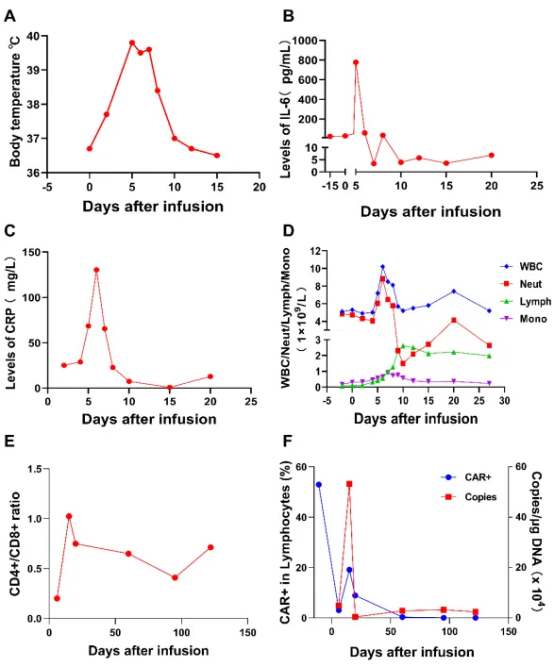
Figure 4: Clinical Response and Key Parameter Levels Following CD19 CAR-T Cell Infusion. (A) Changes in patient body temperature after CAR-T infusion. Temperature rose to 39.8°C on day 5 and began to decline on day 8. (B) IL-6 levels after CAR-T cell infusion. IL-6 peaked on day 5 and returned to normal on day 10. (C) Changes in patient CRP. CRP reached its highest value (130.32 mg/L) within one week post-infusion. (D) Changes in WBC, Neut, Lymph, and Mono. (E) Changes in CD4⁺/CD8⁺ ratio within CD3⁺ T cells. (F) CAR-T cell expansion levels detected by flow cytometry and CAR-DNA copy numbers detected by qPCR. CAR-T and CAR-DNA copy numbers showed a fluctuating decline post-infusion, peaking on day 15 (CAR-T within CD3⁺ T cells: 19.1%; CAR-DNA copy number: 532,350 copies/μg).
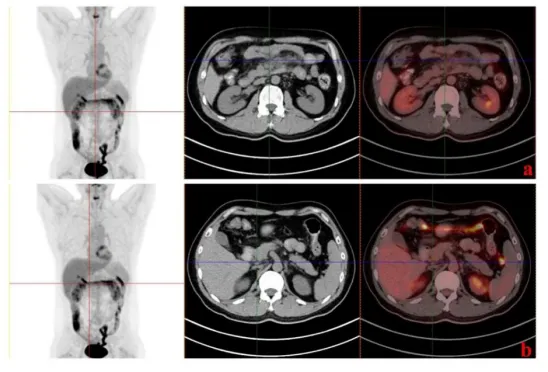
Figure 5: PET-CT at 4 Months Post-Infusion
 Scan to follow our latest news
 Working hours: Monday to Friday, 9:00-18:00
Contact:Ms. Lai
Email:laijiaqi@sz-cell.com
Address:No. 1, Rongtian Road, Jinsha Community, Kengzi Street, Pingshan District, Shenzhen, China (Hepure Biomedical Ecological Park)